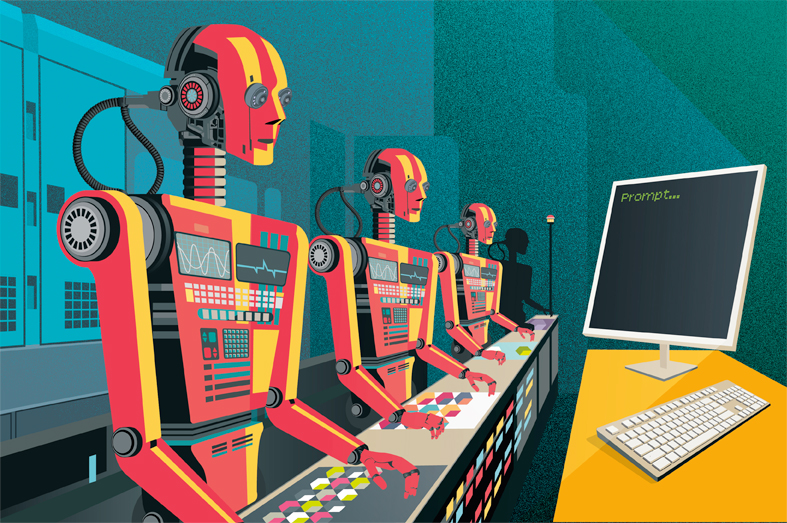
AI is not the enemy of creativity – it is a new instrument in the creative toolkit. But its impact depends on how it is used, and by whom.
This article explores the positive and negative impacts of AI on visual professions, the conflicting nature of accessibility, and how designers and creatives can adapt and thrive in this new landscape.
The Benefits of AI in Creative Work
Increased Efficiency
AI automates time-consuming tasks – such as background removal, image enhancement, layout arrangement, and resizing – saving creatives hours of manual work. This frees professionals to focus on more strategic and conceptual aspects of their craft.
Creative Exploration and Speed
Platforms like Adobe Firefly, Midjourney, and DALL·E allow for rapid idea generation and style exploration. These tools act as digital sketchpads, offering countless visual options in minutes and helping unlock creative directions that may not have been considered otherwise.
Greater Accessibility
AI design platforms make high-quality visual creation possible for non-experts, allowing small businesses, entrepreneurs, and individuals to produce polished content with minimal resources. This democratisation of design opens up creative opportunities for those historically excluded by cost or complexity.
Scalable Personalisation
Custom content—once costly to produce at scale – is now possible using AI. From tailored marketing visuals to personalised photo edits, AI supports dynamic creative output across platforms and audiences.
The Risks and Challenges of AI
Undermining Professional Roles
With AI offering fast, low-cost alternatives, clients may bypass junior designers, photo editors, or freelance illustrators. Entry-level opportunities in particular are at risk, potentially narrowing the pathway for new talent entering the profession.
Devaluation of Design
As AI-generated work becomes more common, clients may begin to view design as a commodity – quick, cheap, and easily replaceable. This undermines the perception of design as a skilled, thoughtful, and strategic process.
Intellectual Property Concerns
Many AI models are trained on datasets scraped from the web, often without consent. This raises ethical and legal questions about plagiarism, copyright infringement, and the exploitation of original work without credit or compensation.
Visual Homogenisation
When many creators rely on the same AI models, the resulting visuals can feel generic or formulaic. This threatens the uniqueness and diversity that characterise strong creative work.
The Paradox of Accessibility
AI’s democratisation of design is both a benefit and a threat. On the one hand, it empowers individuals and smaller organisations to participate in visual creation. On the other, it challenges the relevance and pricing power of trained professionals.
When AI can produce “good enough” results instantly, why hire a designer? For professionals, this is a fundamental shift. The value of creative work is increasingly judged on speed and surface aesthetics, rather than intent, originality, or strategic fit.
Redefining the Role of the Designer
In the AI era, creatives must evolve. The key is not to compete with AI, but to do what AI cannot – think critically, tell stories, interpret nuance, and solve problems with empathy and insight.
Be a Strategic Thinker
AI can generate images, but it cannot understand brand identity, user experience, or emotional resonance. Designers must position themselves as problem-solvers who shape communication – not just aesthetics.
Use AI as a Creative Partner
AI should serve as a tool to enhance – not replace – the design process. Professionals can use AI to generate rough material, then refine, edit, and inject human creativity to produce polished, meaningful results.
Advocate and Educate
Creatives should help clients and stakeholders understand the limits of AI. By highlighting the value of human insight, ethical consideration, and cultural context, designers can differentiate their work from automated alternatives.
Stay Legally and Ethically Informed
Understanding licensing, data use, and intellectual property laws is now essential. Creatives must protect their rights and push for fair regulation in an evolving digital environment.
Conclusion: A Creative Future with AI
AI is not the enemy of creativity – it is a new instrument in the creative toolkit. But its impact depends on how it is used, and by whom.
For graphic designers, illustrators, and photographers, the future lies in adaptation, leadership, and reinvention. Those who embrace AI as a collaborator, while emphasising their uniquely human skills, will not just survive—they will lead.
AI will never replace creativity. But it will force us to redefine it – and that could be the most creative challenge of all.
Contact us to find out more.